A fascinating paper that combines the idea of UVA flocking and wireless clusters by experimenting with miniature prototype helicopters called Proxyflyers.
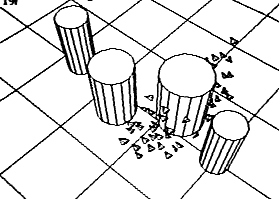
Using research on artificial flocking and swarm systems pioneered by Craig Reynolds. The team at the University of Essex is trying to construct a flock of simple individual agents that can process information like a clustered supercomputer. The work had its beginnings in the Microsystems Laboratory at the California Institute of Technology, where a number of projects from 1997 onwards used a group of up to fourteen autonomous mobile robots, the MooreBots.

In the initial attempt the team explored small remote controlled model aircrafts fitted with a commercial autopilot; however access to UK airspace featured a problem. With the development of an indoor stable coaxial helicopter prototype a new opportunity emerged. Although helicopters their formal flight dynamics is not well understood and no exact mathematical modelling exits they are stable enough to be left hovering on their own with only a slight drift over time. The most important difference to conventional helicopters is their inability to fly sideways, though this may seem a restriction it made the helicopters more similar to Reynolds' biods degree of freedom. With a relative small payload the group opted for very lightweight equipments to be carried. A camera was fitted weighing only 5.5g, a Gumstix system (built-in Bluetooth) able to operate a light Linux operating system weighs only 8g and can further reduce the overall weight by handling some of the controlling of the helicopter with total weight of the helicopter of 76.6g. The helicopter could fly at an altitude of around 6m and transmit video to a server where additional calculation could be made and submitted back. Currently the team is in a position where they have produced an agent candidate; they now have to resolve the issues of autonomous flight and the problems with disturbance in air.
