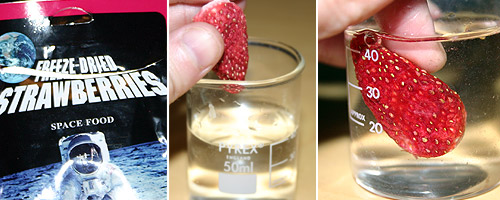
After our “space dessert” of freeze dried strawberries and ice-cream we tried to rehydrate some of these strawberries…..unsuccessfully.
The freeze drying process entails the freezing of the material and reducing surrounding pressure with heat to allow frozen water in material to sublime directly from solid phase to gas. It involves three stages; freezing, primary drying, and secondary drying. As a dehydration process, also known as lyophilization, it is used to preserve perishable materials.

The first stage freezing the material is typically done in a drying flask rotating in bath of liquid nitrogen or dry ice and methanol and the temperature is below the eutectic point of the material to ensure sublimation rather than melting. [The eutectic point occurs at the lowest temperatures where solids and liquid phases can co-exist]
In the second stage, through partial vacuum the pressure is lowered and heat is supplied to the material for the water to sublimate. An excess of heat results in altered structure of the material. A cool condenser chamber provides surface for water to solidify.
The final stage, where the water molecules are adsorbed during freezing process, involves the increased in temperature to break physico-chemical interactions formed between the water molecules and frozen materials. 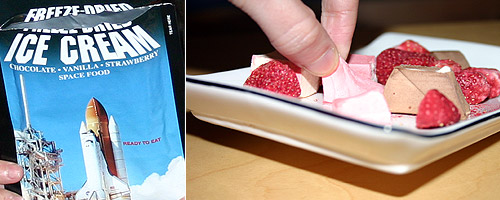
On completions, the vacuum is broken with inert gas before material is sealed. Once our dessert had become sealed packets [to prevent reabsorbtion of moisture] refrigeration is no longer needed.