Reading this article on the Air France magazine October 2007 issue on our way back from Tokyo, I was struck by lack of context in relation to the practice of science and art collaborations.
It was described as "meeting between biotech genius and visual artists has given birth to highly unusual experiment....Le Laboratoire is geared to making the wildest dreams come true: transforming apples into cherries, creating plants that can filter pollutions, inventing clothes that express emotions." The tone of the article is one of shock and surprise - mostly to the editor - who conveniently cutting out (or failed to research) several decades of interesections between these practices, I had to remind myself that this is an airline magazine....
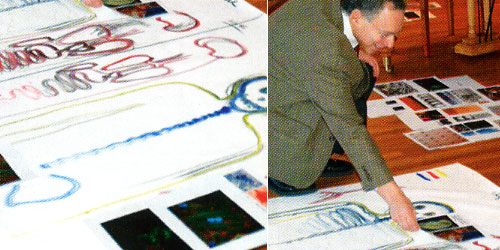
Robert Langer, a scientist heading team of 100 researchers at MIT, and Fabrice Hyber, a visual artist, are collaborating together in an experiment called "Matiere a Penser" which takes place at The Laboratoire this month.
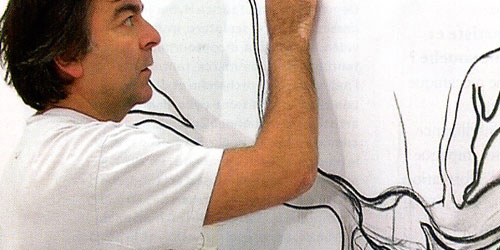
In this interview between Robert and Fabrice, the following ensued. First question pretty obvious one: "Art and science: isn't that an odd mix?" Fabrice told of the idea of working with Robert manifested from his painting in his studio of apple tree with falling cherries where David Edwards (founder of Le Laboratoire) said "We can create this tree, we can make the theory of this painting work." They soon left for MIT together to meet Robert who was working with stem cells. Roberts answers with a "Leonardo da Vinci" answer (art = science) and adds "science provides an opportunity to preserve the world's beauty - even make the world more beautiful than it is." (...and we are back in the modernistic corner of aesthetics....)
Then the article goes onto details of their collaboration - in brief, artist ask scientist lots of questions, artist thinks of exhibition which takes shape in his head based on three elements required for development of stem cells. "the visitor is projected from above into the hear of each of these spaces by sliding into enormous sandbox." After having received two large canvases in which artist has drawn two human bodies, the scientist is asked to write "on them giving the context and favourable food for proper development of cells in each body parts."
How this will pan out in the end is yet to see, but for now it is still about painting. However bad research - finding this kind of reading in an airline magazine does prompt the question of bioart as an emerging genre.