Pattern formation is a hallmark of coordinated cell behavior in both single and multicellular organisms. This type of behavior normally involves cell-cell communication and intracellular processing.
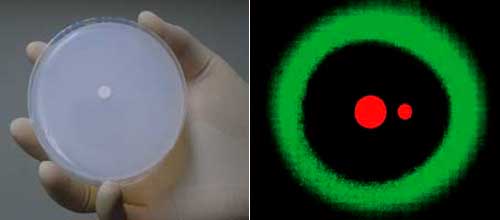
Using a synthetic multicellular system, a group at Princeton University have programmed cells to form ring-like patters when receiving a chemical signal (Acyl-homoserine lactone) from sender cells. The image to the left shows an inoculated petridish where the sender cells in the centre surrounded by a lawn of GFP producing bacteria. The right image is using a fluorescent light to observe the different areas clearly, in the center you can see two colonies of sender cells in red (they are producing red fluorescent protein) which causes the surounding lawn of receiver cells to switch off their GFP production giving rise to a distinct dark area.
A metaphor often used to talk about a group of bacteria is the word 'lawn'. Hence, what can be seen is a bullseye pattern in the lawn surrounded by the sending colony. Potential applications include tissue engineering, biomaterial and biosensing.
Watch a simulation and see the pattern that emerge: