One of our ongoing investigations into life and otherness considers non-terrestrial conditions as a place for habitation. The tool used to investigate these conditions is normally a special vacuum chamber built to simulate parameters such as temperature, gas and distribution, pressure and radiation. Our first entry point to this research when it started around two years ago, was looking at the romantic idea of giving a rose for Mars. Roses bought from a florist are not very good candidates for this environment but perhaps they could survive given some protection. Researchers at NASA have proposed several types of greenhouses that could be used to grow food for future man missions to Mars. Some of these even include using Martian soil as food for plants, hence not totally enclosed. The thought of having a naked rose exposed to these conditions would however give us an idea of how this climate renders a rose in a more dramatic sense. After consultation with Per Nørnberg at the Mars Lab we were given an opportunity to do this experiment. Running the chamber was Jon Merrison who researches as well as develops instrumentation for dust/sand simulation/sampling for terrestrial and Martian environments.
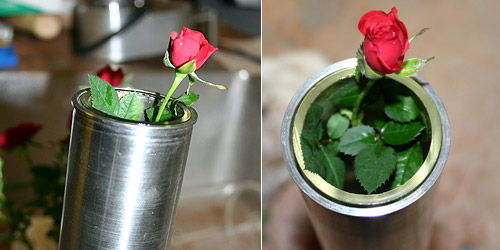
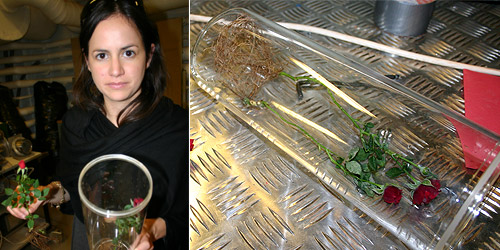
The chamber has some limitation in terms of how big the roses can be, thus we selected a series of miniature patio roses that fit abjust about fit inside the tubes (4 cm diameter / 30 cm height).
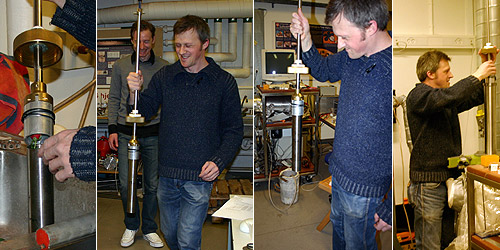
Using a long arm with we could grab onto hold of the tubes and lower the roses down the chamber.
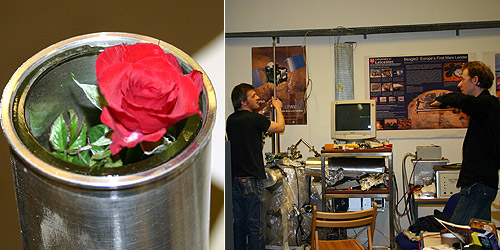
The tubes are first lowered to a holding position and then this space will have the pressure lowered to around 9-10 millibar (Martian pressure). Once this is achieved a hatch is opened and we can lead the tubes into the actual chamber.
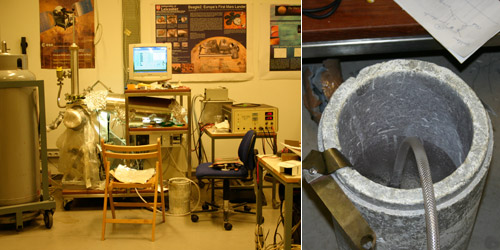
The chamber is controlled by a computer and cooled using liquid nitrogen. A UV-lamp is used to produce radiation conditions and feed into the chamber using a mirror.
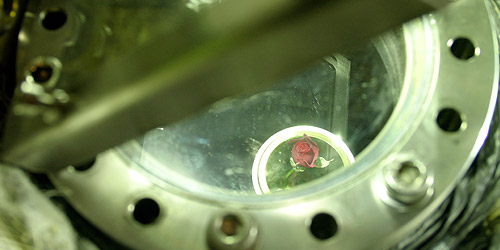
Inside the chamber the tubes are fitted into slots and the samples (normally bacterial) rotate using a carousel that is controlled from the computer. This allowed us to move the rose into position so that the UV shines directly on the plant.
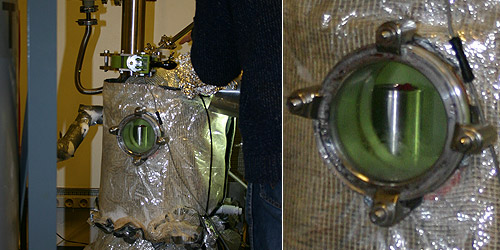
A window on the side allow us to observe and record what happens inside of the chamber. This is particularly useful when operating the carousel.
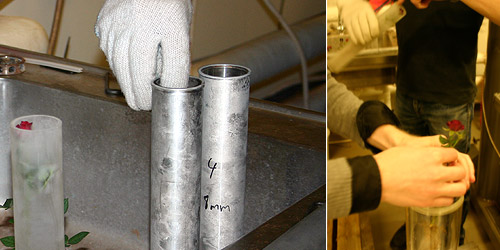
Finally after several hours of exposure the roses were removed from the chamber.
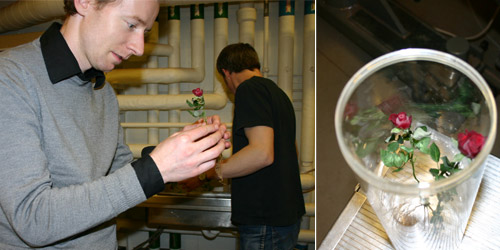
As they started thawing we had to place them in a safe holder for transport back to London.
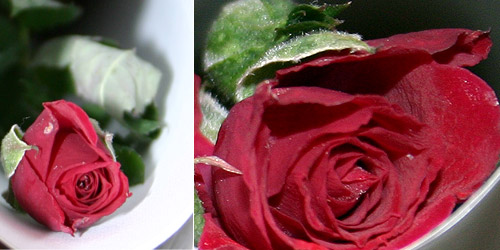
The roses where significantly darker in colour compared to other roses. As they warmed up, they would easily collapse having been exposed to low pressure. Plants have no preadaptation to hyperbaria and infact handles they handle this very poorly by misinterpreting the condition.
To compensate for the fragile state we secured the roses by rolling paper tubes to minimise movement would take place.
The roses will be exhibited as part of an installation at BIOS 4, an exhibition and conference on biotechnological and environmental art at the Centro Andaluz de Arte Contemporaneo in Seville, Spain. [3rd May - 2nd September 2007].
We'd like to extend our sincerest gratitude and appreciation to Jon Merrison for conducting the experiment with us and to Per Nørnberg for helping to co-ordinate the experiment.