Fleshing Out
Fleshing Out seminar is part of a two-day event on material research with the second day being a workshop. The host of this seminar is V2_, an organization for unstable media based in Rotterdam. Specifically to the V2_ spirit is not just to talk but also to demo - picking up on MIT media lab’s slogan demo or die.
Fashioning The Future: tomorrows wardrobe
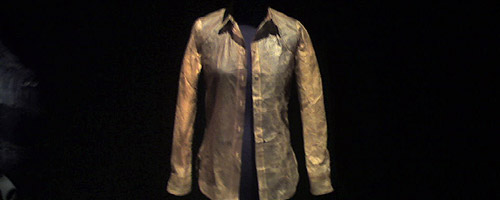
The opening presentation, by Suzanne Lee (UK) from Central Saint Martins College of Art & Design, Fashioning The Future: tomorrows wardrobe, provided an historical overview tracing back to the Italian futurist manifesto and up to the 1960s from which she launched a critic on the development since. The fashion industry after the 1960s has been obsessed with retrorecycling and all areas of fashion with the exception of sportswear have seen no radical technological changes. Examples of sportswear that features embedded technology included the Burton Shield iPod Jacket that allows handling of music devices using buttons on the garment. Other examples included conductive fabric, heat wear, garment which had flexible displays and clothes that could be developed using biotechnology. Suzanne later reappeared with a talk on her own project Bio Couture which is currently being developed. This project uses bacteria that are fed a mix of sugar and tea leaving cellulose as a waste product. By modifying the concentration of the mix and scaffolding the cellulose to sheets, she can use this bacterial waste-product to produce garments. A shirt made from this material had been brought with: it smelt of tea, had a leather/tea-like colouring and felt like something between paper and leather. She did make a clear point that this was work in its infancy and would hopefully be more wearable within a year.
Of Seams and Scars: Tracing technological boundaries and points of attachment
Anne Galloway (CAN) spoke of hybrid or liminal spaces in her talk Of Seams and Scars: Tracing technological boundaries and points of attachment. She posed a critic to how hybrids are presented as pure when it has many constituent parts – she did also comment upon the glitches produced by technology and how this is now becoming an area of exploitation rather than seen as an issue. Most importantly to her talk was the role of process, accepting that one can produce a critic or a meaning that may change overtime and the intentional generation of conflicts and discomfort as a tool.
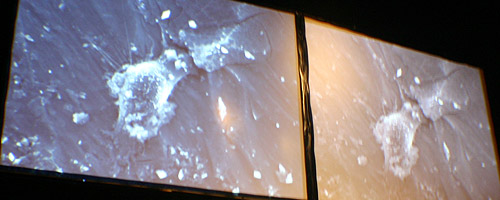
Tobie Kerridge (UK) a designer currently researching at Goldsmiths College presented the collaborative project Biojewellery: Designing rings with bio-engineered bone tissue, where four selected couples had one of their wisdom teeth extracted. A jawbone chip (that normally comes out with the tooth) was taken and tissue-cultured in serum on a moulding scaffold, in order to produce rings that could be worn by the respective partners. The project (surprisingly) also involved the NHS which meant that approval was needed from an ethics committee. The tissue is still being grown but should be ready in short time at which point it will undergo its final design.
move.me, wear.me, hold.me
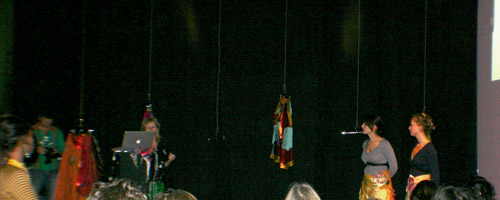
The demonstration session started with a strange and intimate presentation by Thecla Schiphorst (CAN) move.me, wear.me, hold.me. Being an artist at the V2_ allowed her to display more of her work (Exhale), and several dresses including two worn by models. The dresses were fitted with biometric-type switches (pressure/breathing) worn around the chest. Using Bluetooth, the motion of breathing could be translated to another section of the garment and felt as vibrations. The wearer would feel the sensation of breathing on another part of the body. When two wearers came into close proximity of each other the network, allowed vibration to be exchanged (feeling the other wearers breathe).
XS Labs:
An immersive and subversive outlook on garments was shown in the presentation by Joanna Berzowska (PL/CAN/US) XS Labs: Electronic garments that consume the body. Using electronics and shape memory as an integral part of the fabric Joanna can wire the material in such a way that allows pieces of garment to move, inflate and flex. Nitinol is a shape memory alloy (SMA) made from a mixture of nickel and titanium that, once treated to acquire a specific shape, has the ability to indefinitely remember its geometry. She currently working on a dress named Venus where a leaf coiled around the wearers could act to open but also coil itself around the head as if to consume the wearer – adding the notion that clothes should also inflict pain.
Kristina Andersen (DK/UK) had brought with her a wonderful set of boxes each fitted with a particular sensor responding to touch/light/sound by producing some sort of feedback flashing diodes/whirling sounds/etc. Her talk A Naïve Understanding of Electronics looked at ideas of how we formulate an understanding of the technology around us without actually knowing how they work. As an investigation she gives students DIY electronic kits (made for 12 year olds) who will try to put them together on their own accord. As a result of this hacking process new, unintended and amusing electronic devices are built. Her research focuses very much on children to whom she gives simple devices to play with thereby finding unintended uses (and narrations) of the devices.
Creative R&D, Profitable Business
In the second series of presentation Ger Brinks (NL) spoke of Creative R&D, Profitable Business and what he believed constituted sustainable business models - at the end of the day it’s all about making money. Important to his model was the innovation of existing models and being tactful when following trends.
The final presentation was held by Ionat Zurr (ISR/AUS) this time representing Tissue Culture and Art Project (TC&A). Her talk The Victimless Utopia is almost becoming a traditional presentation (having seen it a few times before) but had some interesting new comments. Starting off with the artists getting their hands wet manifesto she moved onto the naked ape, touching some theories around how we could have evolved. Following the history of tissues culture looking back to Julian Huxley, a eugenicist, Ionat pondered the question of perhaps, eugenics is eventually where tissue engineering leads. Next, the mouse with an ear on its back was shown in a loop opposite a photo slide of Vacanti and his wife at the TC&A Pig Wing Project exhibition. Ionat raised some criticism to whether Vacanti’s work was perhaps a PR stunt seeing that the ear collapsed only three days after the video was shot and there was probably no little child waiting for the ear. By now I think you are shocked…she provokes as she opens a video showing a large box, which upon opened revealed hundreds of rabbit’s heads frozen - ready for culture extraction. For the Disembodied Cuisine, muscle cells were grown to form a very small piece of meat, cooked and eaten during an exhibition period. The irony of utopia is that the serum used is produced from calf blood and the ratio is 1 calf to produce 100g of victimless meat with a possible market price of $60(US) per gram. TC&A has an almost constant theme of technological failures and Victimless Leather lends itself also to the previous construction of the failed utopia. In its sterile container it almost produces a jail cage to the dream of a second skin.
virtueel platform
The workshop the next day was hosted by virtueel platform and took place in Amsterdam at Pakhuis De Zwijger. There were four groups covering themes of Critical Intervention (Kristina Andersen), Material Science (Michiel Scheffer), Grow Your Own (Tobie Kerridge) and Bridging Bodies (Thecka Schiphorst).
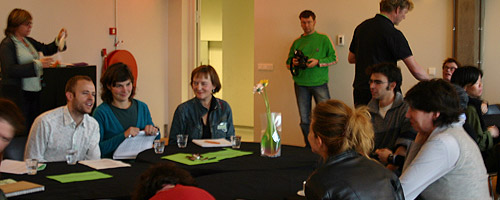
I took part in the Grow Your Own group where we discussed methods of collaboration, differences and similarities between science and art and strategies to produce a common ground. The group was then divided up to further the discussion and find something we could grow that would relate to this event - fleshing out - and what it would take to make that happen. Ideas we discussed within our group included wearable ecologies, 3D polymer printing, garments that absorbs (perhaps, collects gold) and reflect the environment around you as well as garments that eats itself. Constant issues of sterilization and confinements came up - if you wear something that is living you cannot go anywhere with it, it will cross-pollinate and contaminate. Policies currently make these type of clothing very difficult to produce, seeing that Ionat has been blacklisted in Australia for bringing an apple into the country!
why
The workshop cumulated with a discussion on why and the technological imperative – just because the technology is there, do we have to use it? The latter is an important current question for c-lab as a group.