
The surrounding area of Cape Town is a treasure for wine lovers. Here, the climate is mild Mediterranean and with slow folding carpets of clouds resting on mountain tops.
As you enter the wine farms for a cosy Thursday afternoon tasting, it is the traditional wine farming rather than modern biotechnology that spring to mind. Nevertheless it can be thoughtful to consider some of the changes that are happening to the wine industry.

The central research institute in the area is Stellenbosch University which runs the Winetech Vine and Wine Biotechnology Program focusing on grapevine, bacterial and yeast (Saccharomyces cerevisiae) biotechnology. In contrast to America where genetically modified wine yeast has already received approval and could be marketed and sold, no GM yeast has yet been submitted in South Africa for approval. In Europe legislation is underway but will need labelling. 
In what way could these new GM yeast and GM vines improve wine? Currently, wine industry relies on Sulfur dioxide to ensure high-quality, however a demand in the reduction of preservatives could yield a shift towards biological preservatives. A yeast is currently being developed that can help control the growth of unwanted micro-organisms. Another yeast strain that is being looked at could also enhance the fermentation process making the whole process a lot quicker and for flocculation to occur at the right time. Finally, the actual taste of the wine could be explored with new strains of yeast allowing new styles to be developed.
However, safety could still be an issue. The most critical issue normally encountered with fungi is that it genetically belongs to a similar group as humans and it may therefore be difficult to treat infections. Recently, a test of a GM yeast in Japan used to enhance flavour in sake showed that it preserved fatty acid mutant in the chromosome.
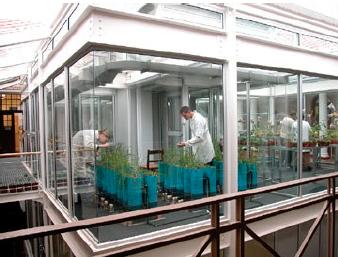
Photo: Ivan Volschenk, IWBT, University of Stellenbosch
For the development of virus resistant plants the research centre has also established a greenhouse and facilities to develop and evaluate transgenic plants which are currently being produced using either gene silencing or cross-transfer.